How Instagram's ranking signals shifted from 2024 to 2026 — and what it means for brand campaigns
MountLift Research — a synthesis of public platform statements and third-party tracking data, with our analysis of what it means for influencer campaign strategy.
Why this matters for brands, not just creators
Most "Instagram algorithm" content is written for creators trying to grow their own following. Brands evaluating influencer partnerships need a different lens: which creators are positioned to keep their reach as the platform's ranking systems shift, and which campaign formats are likely to get amplified or throttled regardless of how good the content is.
This piece pulls together what Instagram has actually confirmed publicly between 2024 and 2026, cross-references it against independent tracking data, and lays out what we think it means for how brands should brief creators and allocate budget going forward.
A note on sourcing: every claim below is attributed. Where the underlying data is platform-confirmed, we say so. Where it's a third party's interpretation or aggregated tracking data, we say that too. Where we're offering our own read, it's labeled as analysis, not fact.
The starting point: Instagram's 2024 ranking framework
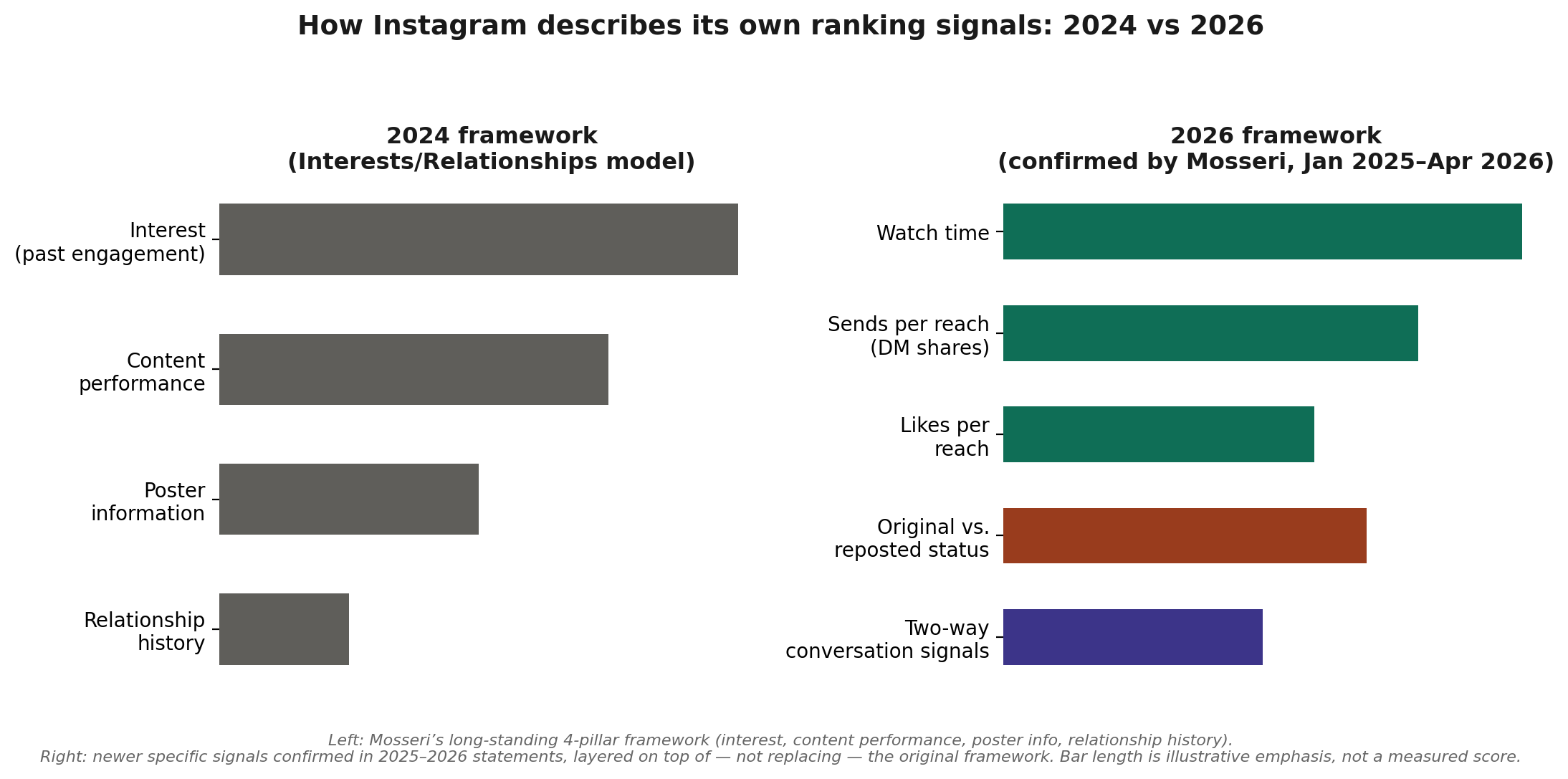
Instagram has been consistent for several years that there is no single "algorithm" — the platform runs separate ranking systems for Feed, Stories, Reels, Explore, and Search, each weighting signals differently depending on what job that surface is doing for the user. Instagram head Adam Mosseri has described the long-standing framework as resting on four pillars: what a user has engaged with in the past (interest), how a piece of content is performing with others, information about the person who posted it, and the relationship history between poster and viewer.
This four-pillar model was the baseline going into 2024 and remains the backbone of how Instagram describes its systems even now — the 2025–2026 changes layer more specific, named signals on top of it rather than replacing it outright.
What changed: three confirmed shifts between 2024 and 2026
1. Three signals were named as the most important, across every surface
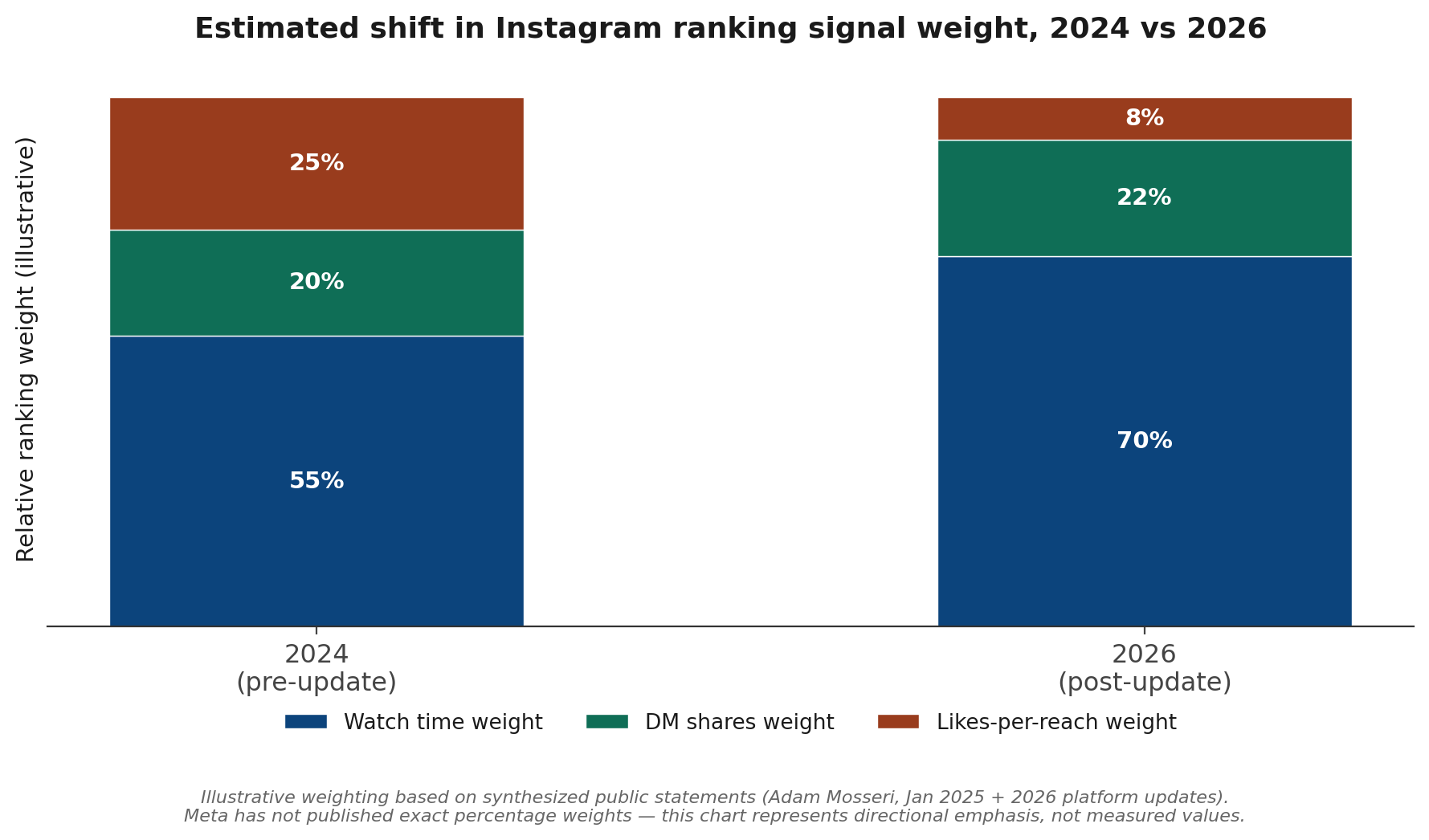
In January 2025, Mosseri confirmed publicly that three specific signals now matter most across Feed, Reels, Stories, and Explore: watch time, likes-per-reach, and sends-per-reach (DM shares). Watch time was identified as the single most important factor — if people don't watch, content doesn't rank well regardless of other signals. The relative importance of the other two depends on what a creator or brand is optimizing for: likes-per-reach matters more for reaching existing followers, while sends-per-reach matters more for reaching new audiences through recommendations.
By 2026, third-party trackers reporting on creator behavior describe DM shares as outweighing likes by a significant margin when it comes to unconnected reach — Instagram is reported to treat a DM share as the strongest available signal that content is worth recommending to people who don't already follow the account, because it represents an active, private endorsement rather than a passive tap.
Our take: this is the single most actionable shift for brand campaigns. A creator brief built around "create something likeable" is now arguably optimizing for the wrong metric if the campaign's goal is reaching new audiences rather than re-engaging an existing fanbase. Save-worthy and share-worthy content (tips, transformations, things people send to a friend with "you need to see this") line up better with how unconnected reach is reportedly being distributed in 2026 than content designed purely to rack up likes.
2. Original content now receives a measurable, platform-stated distribution advantage
In April 2026, Instagram extended a policy — previously applied to Reels in 2024 — to photos and carousels: content that is reposted without modification is now actively deprioritized in recommendations, and accounts that primarily aggregate others' content (defined as posting 10 or more reposts within a rolling 30-day window) are excluded from recommendations entirely. Instagram has stated original content can receive substantially more distribution than repurposed content, with some industry trackers citing a reported range as high as 40-60% more reach for unmodified original posts versus reposts, and others citing platform language suggesting original content may see distribution up to 3x that of repurposed content in certain cases — the exact multiplier isn't uniformly disclosed, and different trackers report different figures, which is itself worth noting as a sign that this is being estimated externally rather than published as a single hard number by Meta.
What counts as "original" has a specific technical bar: Instagram is reported to use content-fingerprinting to detect material that was first posted elsewhere, including reposts from other platforms with their watermarks still attached — Mosseri has specifically clarified that videos made in Meta's own Edits app are not penalized, but a visible competitor watermark (e.g. a TikTok logo) on a cross-posted video does reduce distribution.
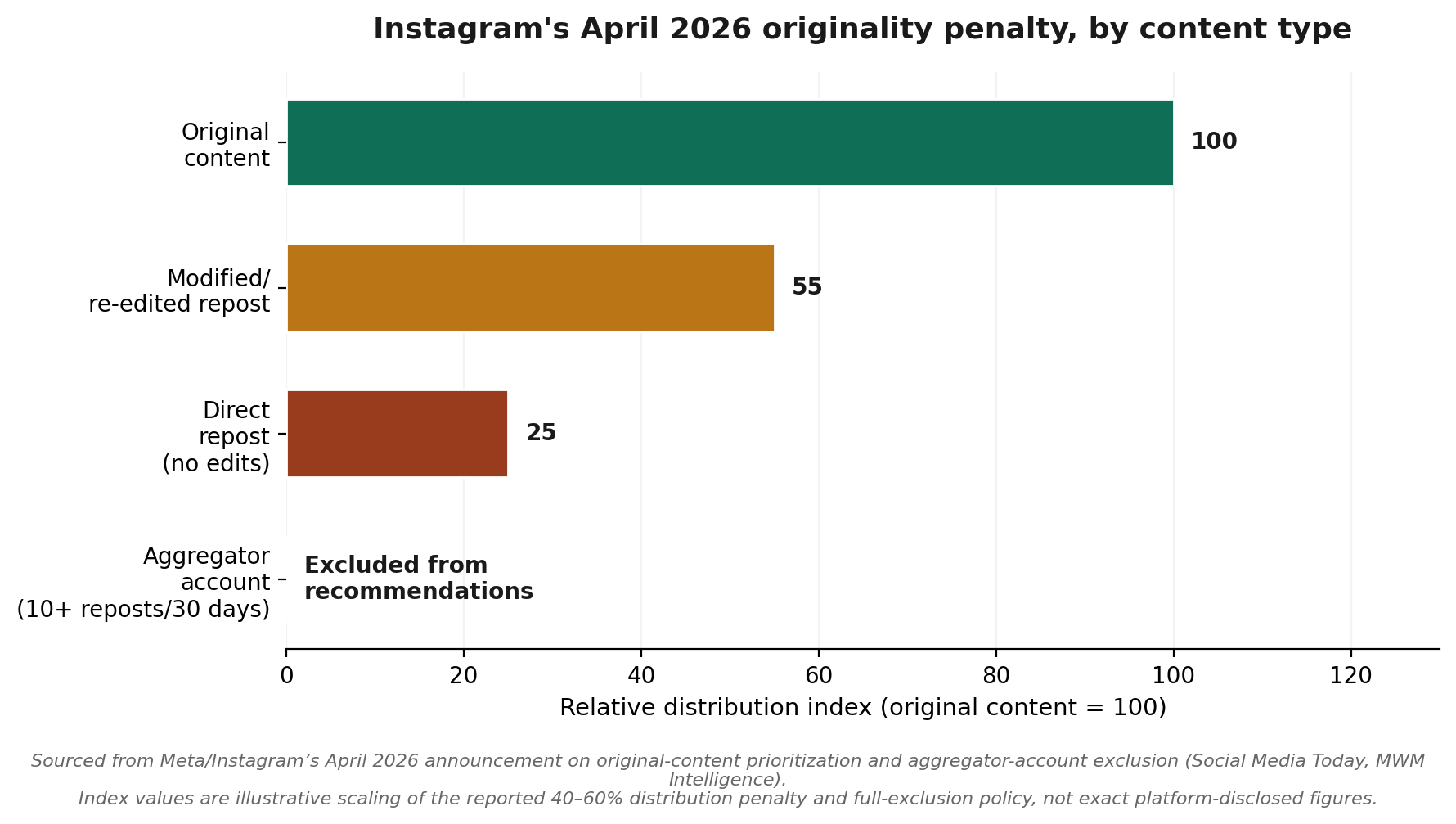
Our take: for brands running campaigns that lean on creators repurposing the same core video across platforms, this is a real cost, not a minor inconvenience. A brief that asks for one video adapted (re-recorded or substantially re-edited) for each platform separately is likely to outperform a brief asking for one video distributed identically everywhere — not just for engagement quality reasons, but because Instagram's distribution systems are now explicitly built to suppress the latter.
3. "Audition" testing and two-way engagement now factor into reach more directly
Mosseri has confirmed Instagram tests content with a small sample of non-followers before deciding how far to distribute it — sometimes described as an "audition system" — meaning the first few seconds of viewer behavior on a small test audience can determine whether a piece of content ever reaches a creator's full following, let alone new audiences. Industry trackers report this test window happens within the first 1–2 hours after posting, with strong early performance triggering wider distribution.
Separately, Instagram has indicated that accounts with which a user has genuine two-way interaction — replying to DMs, responding to comments, story reply exchanges — are weighted more favorably in that user's Feed and Stories tray. This is described as a relationship-strength signal, consistent with the long-standing "relationship history" pillar, but now framed as something actively reinforced by ongoing conversation rather than just past viewing history.
Our take: the audition mechanic raises the stakes on the first three seconds of any piece of sponsored content, which was already creative best practice — but it also means a weak hook isn't just a missed-opportunity problem, it can functionally cap a video's reach for everyone, including existing followers. Worth flagging explicitly in creative briefs rather than leaving it as an assumed norm.
Putting it together: estimated shift in signal emphasis
The chart below is our own illustrative synthesis — not a Meta-published breakdown — built by weighing the public statements above into a directional comparison. Treat the percentages as relative emphasis, not measured platform data; Meta has not released exact signal-weighting percentages for either year.
What we'd actually change in a campaign brief based on this
A few concrete adjustments we're making to how we brief creators, based on the above:
- Lead with save-and-share-worthy formats over like-bait. If a campaign's goal includes reaching new audiences (not just engaging an existing community), prioritize formats that give people a reason to send the content privately — practical tips, surprising comparisons, things with a punchline worth forwarding — over formats optimized purely for likes.
- Treat platform-specific re-editing as a budget line, not an afterthought. If a brand is running the same campaign concept across Instagram, TikTok, and YouTube Shorts, build in time and creator hours for genuine re-cutting per platform rather than identical cross-posting. The cost of a slightly longer production timeline is likely smaller than the cost of being algorithmically deprioritized.
- Push harder on first-3-second hooks in creative review. This was already standard advice, but the audition-testing mechanic means a weak opening doesn't just underperform — it can suppress a video's reach before most of the intended audience ever sees the rest of it.
- Don't assume hashtags are doing heavy lifting. Multiple sources we reviewed describe hashtags as a minor signal in the current system, useful for topical/keyword relevance rather than discovery in the way they functioned years ago. We wouldn't recommend brands evaluate creator performance based on hashtag strategy at this point.
Sources
This piece synthesizes public statements and third-party tracking/analysis from the following:
- Adam Mosseri's public statements on Instagram ranking, as reported via creators.instagram.com (February 2026) and Buffer's algorithm guide
- Social Media Today's reporting on Instagram's April 2026 original-content policy expansion
- MWM Intelligence's analysis of the April 2026 originality update and Edits app data
- Industry trackers and guides referencing Mosseri's January 2025 confirmation of watch time, likes-per-reach, and sends-per-reach as primary ranking signals, including coverage from CreatorFlow, LIT School, and Watsspace
- MeetEdgar's 2026 Instagram algorithm guide, covering Trial Reels and surface-specific ranking behavior
MountLift did not conduct independent platform testing for this piece. Where sources disagreed on specific figures (e.g. the exact distribution multiplier for original content), we've noted the disagreement rather than picking one number to present as settled fact.